Chapter 16 · note 62 · p. 324
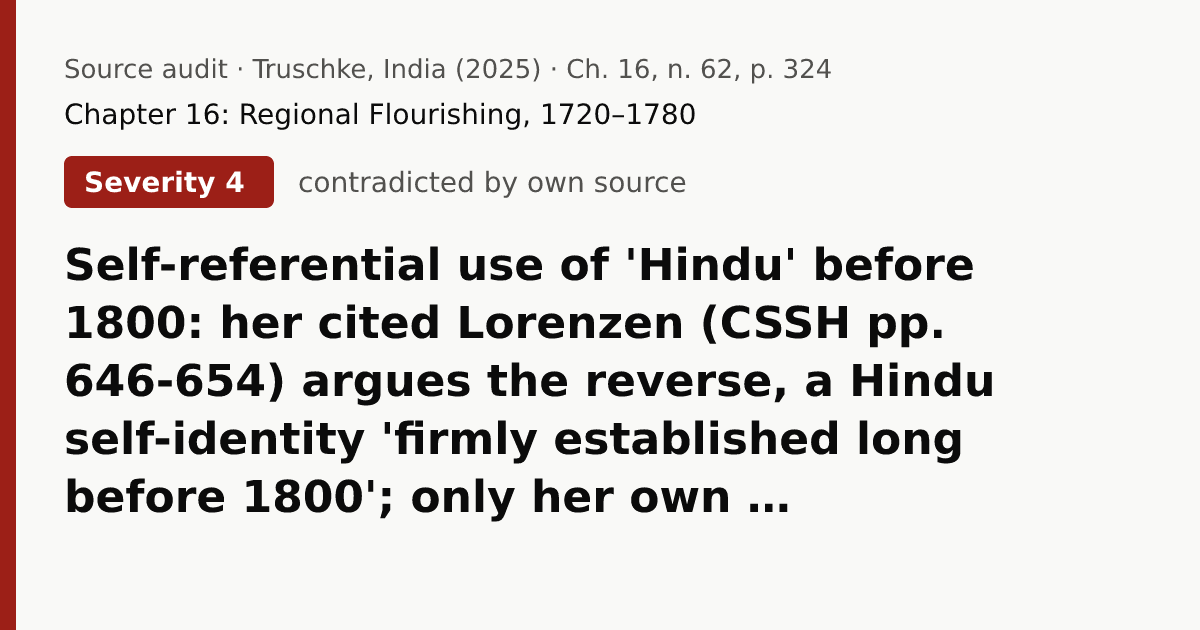
Self-referential use of 'Hindu' before 1800: her cited Lorenzen (CSSH pp. 646-654) argues the reverse, a Hindu self-identity 'firmly established long before 1800'; only her own co-cited article supports her
"hindu" 'was scarcely used self-referentially in premodern India'; between 1200 and 1800 it 'mostly surfaced in Persian texts' with a geographic sense
Read in the cited CSSH 41.4 pagination (replaces the typescript locator). Lorenzen p. 646: the evidence against the claim that Hindus lacked a religious self-identity before 1800 is 'so overwhelming'; pp. 648-652: vernacular poets (Ekanath, Anantadas, Kabir, Vidyapati) use 'Hindu' for a religious community, evidence 'clear and abundant'; p. 652: Andhra inscriptions from 1352; p. 653: Isami (1350) uses hindu for a follower of the religion. He agrees 'Hindu' never entered the premodern Sanskrit lexicon (p. 647) and that religious and geographic senses 'coexisted' (p. 634). Co-cited: Truschke, 'Hindu' (her own work, check 15) pp. 249-260 reads the same examples as sparse: currency mainly in Persian poetry; religious uses before 1600 'few and far between'.
Details
Citation and source
- Source (edition used)
- Lorenzen, 'Who Invented Hinduism?', Comparative Studies in Society and History 41.4 (1999), 630-659 cited; checked in the author's typescript of October 1999 with its own pagination (other edition; the CSSH pinpoint cannot be verified)
- Source locator
- typescript pp. 2, 6, 21-28 (cited as CSSH pp. 646-654)
- Her note
- Lorenzen, “Who Invented Hinduism?,” 646–654; Truschke, “Hindu,” 249–260.
- Cited for
- Premodern uses of the word 'Hindu' (Lorenzen 646-654)
What her source says, in full
Read in the cited CSSH 41.4 pagination (replaces the typescript locator). Lorenzen p. 646: the evidence against the claim that Hindus lacked a religious self-identity before 1800 is 'so overwhelming'; pp. 648-652: vernacular poets (Ekanath, Anantadas, Kabir, Vidyapati) use 'Hindu' for a religious community, evidence 'clear and abundant'; p. 652: Andhra inscriptions from 1352; p. 653: Isami (1350) uses hindu for a follower of the religion. He agrees 'Hindu' never entered the premodern Sanskrit lexicon (p. 647) and that religious and geographic senses 'coexisted' (p. 634). Co-cited: Truschke, 'Hindu' (her own work, check 15) pp. 249-260 reads the same examples as sparse: currency mainly in Persian poetry; religious uses before 1600 'few and far between'.
Material the text leaves out
Lorenzen CSSH pp. 646-652: his thesis that a Hindu religious identity, voiced with the word 'Hindu' in vernacular texts and inscriptions from the fourteenth century, was well established before 1800; n62 cites these pages with no signal of disagreement.
Strongest defence considered
Claude pre-pass
Her own co-cited 2023 CSSH article, a full study of the term, finds pre-1800 uses of 'hindu' light and mostly Persian and reads Lorenzen's own examples (Vidyapati, Kabir, Eknath, Vijayanagara titles) as sparse; 'scarcely', 'mostly' and 'often' are hedges, and Lorenzen concedes the Persian origin, the absence from Sanskrit and the coexisting geographic sense.
Why the finding still stands
defence fails. The cited Lorenzen pages argue the opposite on both halves of her sentence (self-reference and the geographic sense), and he writes against the very position she states; hedges cannot carry a reversal of the source's thesis. 4 stands, pending the CSSH pagination check and her own essay.
What would change this
Evidence that Lorenzen's vernacular examples are not self-referential uses of 'Hindu', or a reading of n62 in which Lorenzen is cited as the opposing view (it carries no 'cf.').
Status
Severity 4the sentence is false or contradicted by her own cited source
Class: contradicted by own sourcechecked in another edition; pending check against the cited edition
Everything in the record
- Work id (works.csv)
- B0847
- Source language
- English (original)
- Event type
- other
- Portrayal of the actor compared with the source (single coder)
- neither
- Check(s)
- 2;15;19
- Page
- 324
- Endnote
- 62
- Run
- claude
- Model
- claude-opus-5-5
- Effort
- high
- Confidence
- medium
- Adjudication record
- pending (edition check): checked in another edition; pending check against the cited edition; severity-4 rule: graded by impact (ruling 1) | defence pass 2026-11-18: defence fails. The cited Lorenzen pages argue the opposite on both halves of her sentence (self-reference and the geographic sense), and he writes against the very position she states; hedges cannot carry a reversal of the source's thesis. 4 stands, pending the CSSH pagination check and her own essay. | rerun 9 (2026-11-19): the CSSH pagination is now held and the cited pp. 646-654 carry the contrary argument earlier read in the typescript (edition check resolved). Her co-cited article (pp. 249-260, her own work) reads the evidence her way: source disagreement under ruling 2. defence considered 2026-11-19: under ruling 6 the agreeing secondary reading does not clear or lower the finding, which rests on the source she cites; Lorenzen's article says the reverse of her sentence and calls the stated position mistaken, and n62 cites it as support. 4 stands.
- Adjudicated by
- claude (defence pre-pass; operator calls)
- Language review
- not needed
- Status
- live
- First published
- v1
- Last changed
- 2026-11-23
India (2025): A Source AuditFinding ID ch16-032