Chapter 13 · note 15 · p. 245
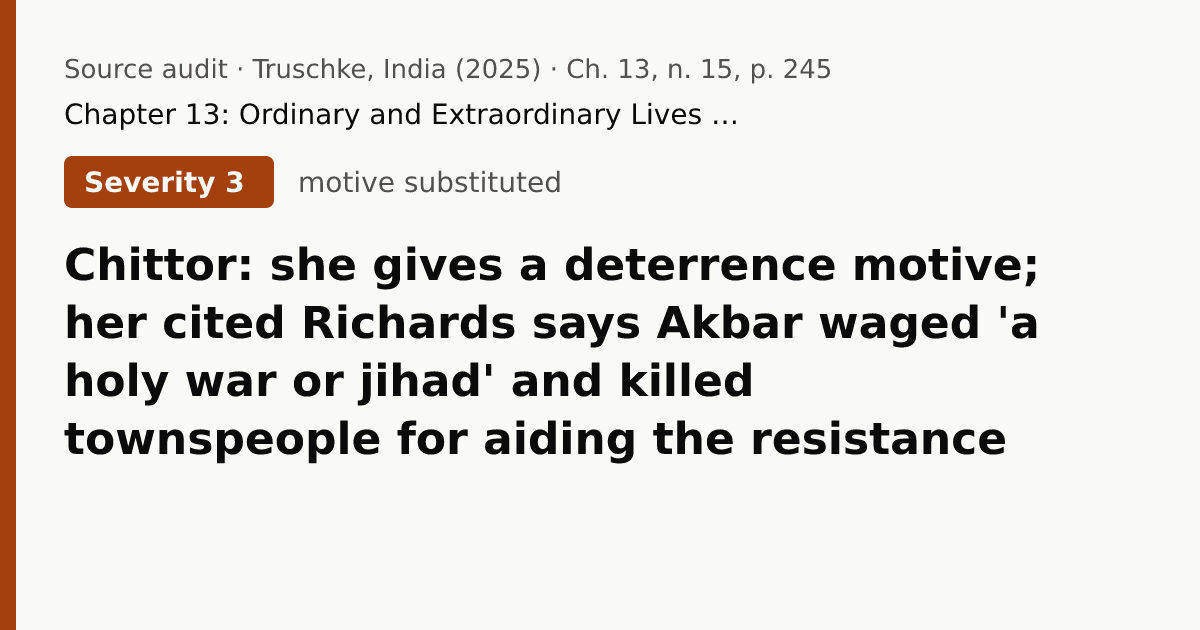
Chittor: she gives a deterrence motive; her cited Richards says Akbar waged 'a holy war or jihad' and killed townspeople for aiding the resistance
At Chittor Mughal forces 'massacred 30,000 people, including many civilians'; the brutality was 'a shock-and-awe strategy, designed to instill fear'.
Count supported. Kolff p. 10 reports from Abul Fazl that 8,000 Rajputs and some 40,000 peasants defended Chittor and that Akbar had 'nearly 30,000' killed; Richards p. 26 gives the garrison's death plus 20-25,000 townspeople and peasants. Motive: Richards p. 25 says Akbar 'sought to impress the superiority of his faith' over Rajput warriors; p. 26 says he led his armies 'in a holy war or jihad toward Chitor' after Udai Singh's son fled his court, and that the 20-25,000 were killed 'on the grounds that they had actively helped in the resistance'. Kolff p. 10 gives the same ground (the peasants' share in the defence, which Abul Fazl used to justify the killing). Partial support for her reading: Richards p. 25 (Timurid authority 'lessened in Rajput eyes' unless the Rana submitted) and p. 27 (the sieges 'demonstrated the reality of Mughal power'); Fisher (n9) says other Rajputs took note of the 'ruthless perseverance at Chittor'. Pages 25-27 of Richards read.
Details
Citation and source
- Source (edition used)
- Richards, The Mughal Empire (New Cambridge History of India I.5, Cambridge UP, 1995 as cited; library copy a 2001 reprint of the same edition); Kolff, Naukar, Rajput and Sepoy: The Ethnohistory of the Military Labour Market in Hindustan, 1450-1850 (Cambridge UP, 1990)
- Source locator
- Richards pp. 25-27; Kolff pp. 10-11
- Her note
- Kolff, Naukar, Rajput and Sepoy, 10 (number 30,000); Richards, Mughal Empire, 26 (Chittor’s fall). I am indebted to Roy Fischel for the phrase “shock and awe” to describe Mughal actions at Chittor.
- Cited for
- The 30,000 figure (Kolff p. 10) and Chittor's fall (Richards p. 26)
What her source says, in full
Count supported. Kolff p. 10 reports from Abul Fazl that 8,000 Rajputs and some 40,000 peasants defended Chittor and that Akbar had 'nearly 30,000' killed; Richards p. 26 gives the garrison's death plus 20-25,000 townspeople and peasants. Motive: Richards p. 25 says Akbar 'sought to impress the superiority of his faith' over Rajput warriors; p. 26 says he led his armies 'in a holy war or jihad toward Chitor' after Udai Singh's son fled his court, and that the 20-25,000 were killed 'on the grounds that they had actively helped in the resistance'. Kolff p. 10 gives the same ground (the peasants' share in the defence, which Abul Fazl used to justify the killing). Partial support for her reading: Richards p. 25 (Timurid authority 'lessened in Rajput eyes' unless the Rana submitted) and p. 27 (the sieges 'demonstrated the reality of Mughal power'); Fisher (n9) says other Rajputs took note of the 'ruthless perseverance at Chittor'. Pages 25-27 of Richards read.
Strongest defence considered
Claude pre-pass
Richards himself supports a demonstration-of-power reading: Timurid authority 'lessened in Rajput eyes' unless the Rana submitted (p. 25) and the sieges 'demonstrated the reality of Mughal power' (p. 27); Fisher notes other Rajputs took note of the 'ruthless perseverance at Chittor'. Deterrence is a mainstream reading.
Why the finding still stands
defence fails. Her own cited Richards page states that Akbar marched 'in a holy war or jihad toward Chitor' and that the 20-25,000 were killed for aiding the resistance, the ground Abul Fazl gave (Kolff p. 10); giving deterrence as the sole design is one side of a split that changes why (ruling 2).
What would change this
A passage in Richards or Kolff stating deterrence as the reason for the killings, or evidence that the holy-war framing is Richards's gloss rather than his sources'.
Status
Severity 3changes the meaning of the sentence
Class: motive substituted
Everything in the record
- Work id (works.csv)
- B1077;B0805
- Source language
- English (original)
- Count in source
- nearly 30,000 (Kolff, from Abul Fazl); garrison of 5,000 plus 20-25,000 townspeople and peasants (Richards)
- Count in her text
- 30,000
- Actor
- Akbar / Mughal forces
- Actor affiliation (as the source states)
- Mughal
- Event type
- massacre
- Event date
- February 1568
- Place
- Chittor
- Motive in source
- mixed
- Motive in her text
- political
- Portrayal of the actor compared with the source (single coder)
- better
- Check(s)
- 2;8;9;11
- Page
- 245
- Endnote
- 15
- Run
- claude
- Model
- claude-opus-5-5
- Effort
- high
- Confidence
- high
- Adjudication record
- defence pass 2026-11-18: defence fails. Her own cited Richards page states that Akbar marched 'in a holy war or jihad toward Chitor' and that the 20-25,000 were killed for aiding the resistance, the ground Abul Fazl gave (Kolff p. 10); giving deterrence as the sole design is one side of a split that changes why (ruling 2). | rerun 9 (2026-11-19): Nath p. 265: Akbar 'ordered a mass slaughter (qatl-i amm) of the population', which Abul Fazl justified as deserved by defenders and commoners who had resisted; Nath n. 142 infers that a wish to make a political statement 'must also have' played a part, but 'this is not something that Mughal texts mention'. Talbot p. 338: 'nearly thirty thousand were killed in the fighting inside the fort' (support for her 'ensuing fighting'). Under ruling 6 Nath's inference is defence, not clearance. Unchanged at 3.
- Adjudicated by
- claude (defence pre-pass; operator calls)
- Language review
- not needed
- Status
- live
- First published
- v1
- Last changed
- 2026-11-23
India (2025): A Source AuditFinding ID ch13-005