Chapter 8 · note 91 · p. 155
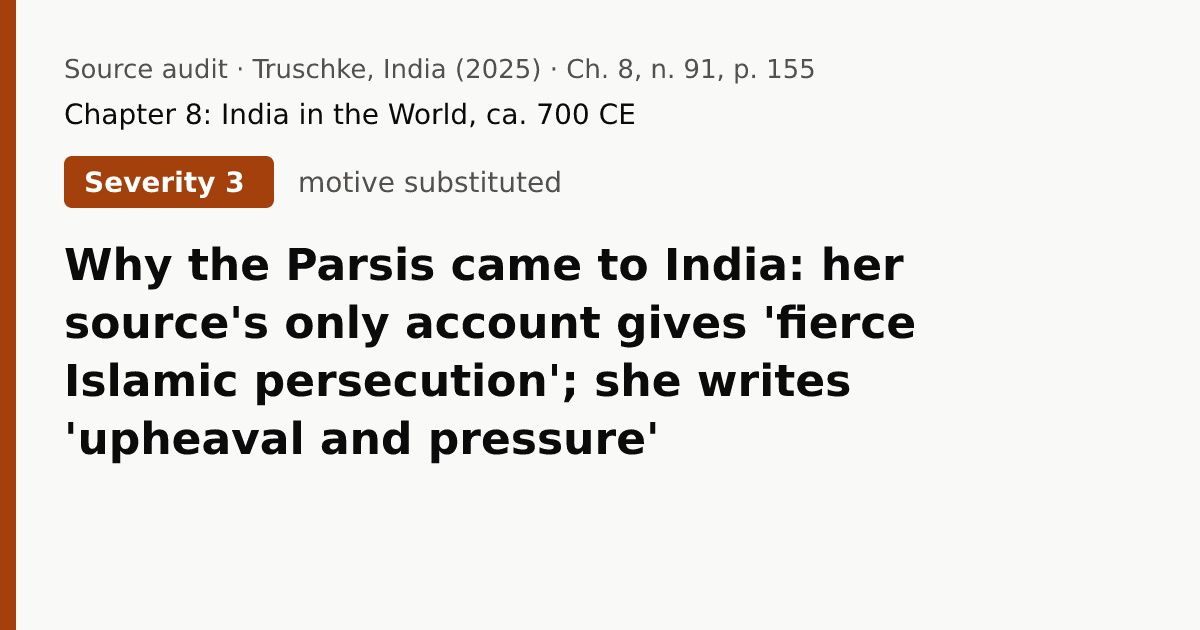
Why the Parsis came to India: her source's only account gives 'fierce Islamic persecution'; she writes 'upheaval and pressure'
Parsis came 'to escape the upheaval and pressure' of the Sasanian fall and Muslim-led rule.
Hinnells: the settlement came from 'Zoroastrian refugees' leaving 'medieval Islamic Persia'. Proposed dates run from 716 to 936 CE. The only source, the Qessa-ye Sanjan, describes hiding 'during a time of fierce Islamic persecution'. Hinnells adds that it was written in 1600 from oral tradition. She gives 'upheaval and pressure' and 'by around 700', earlier than any date Hinnells reports.
Details
Citation and source
- Source (edition used)
- Hinnells, 'Parsi Communities i. Early History', Encyclopaedia Iranica (2008)
- Source locator
- opening section; Wayback capture 2024-12-27 (live site returns HTTP 403)
- Her note
- Hinnells, “Parsi Communities” (citing dates from the early 700s forward).
- Cited for
- Parsi migration and its dates
What her source says, in full
Hinnells: the settlement came from 'Zoroastrian refugees' leaving 'medieval Islamic Persia'. Proposed dates run from 716 to 936 CE. The only source, the Qessa-ye Sanjan, describes hiding 'during a time of fierce Islamic persecution'. Hinnells adds that it was written in 1600 from oral tradition. She gives 'upheaval and pressure' and 'by around 700', earlier than any date Hinnells reports.
Strongest defence considered
Claude pre-pass
Hinnells calls them 'Zoroastrian refugees' from 'medieval Islamic Persia' and warns that the Qessa, written in 1600 from oral tradition, must be used 'with due caution'; 'escape the upheaval and pressure... of Muslim-led rule' conveys flight from Muslim rule.
Why the finding still stands
defence partly. Actor and direction of the push are right; 'pressure' softens the source's only account ('fierce Islamic persecution'), which Hinnells himself treats cautiously. 'Around 700' versus 716 at earliest is within rounding. A softened motive with a real source caveat: 2.
What would change this
Hinnells's caution about the Qessa read as rejecting its persecution motive.
Status
Severity 3changes the meaning of the sentence
Class: motive substituted
Everything in the record
- Work id (works.csv)
- B0685
- Source language
- English (original)
- Count in source
- 716-936 CE
- Count in her text
- by around 700 CE
- Actor
- Muslim rulers of Persia
- Actor affiliation (as the source states)
- Muslim rulers
- Event type
- other
- Motive in source
- religious
- Motive in her text
- political
- Portrayal of the actor compared with the source (single coder)
- better
- Check(s)
- 1;2;9;8
- Page
- 155
- Endnote
- 91
- Run
- claude
- Model
- claude-opus-5-5
- Effort
- high
- Confidence
- medium
- Adjudication record
- defence pass 2026-11-18: defence partly. Actor and direction of the push are right; 'pressure' softens the source's only account ('fierce Islamic persecution'), which Hinnells himself treats cautiously. 'Around 700' versus 716 at earliest is within rounding. A softened motive with a real source caveat: 2.
- Adjudicated by
- claude (defence pre-pass; operator calls)
- Language review
- not needed
- Status
- live
- First published
- v1
- Last changed
- 2026-11-21
India (2025): A Source AuditFinding ID ch08-068